
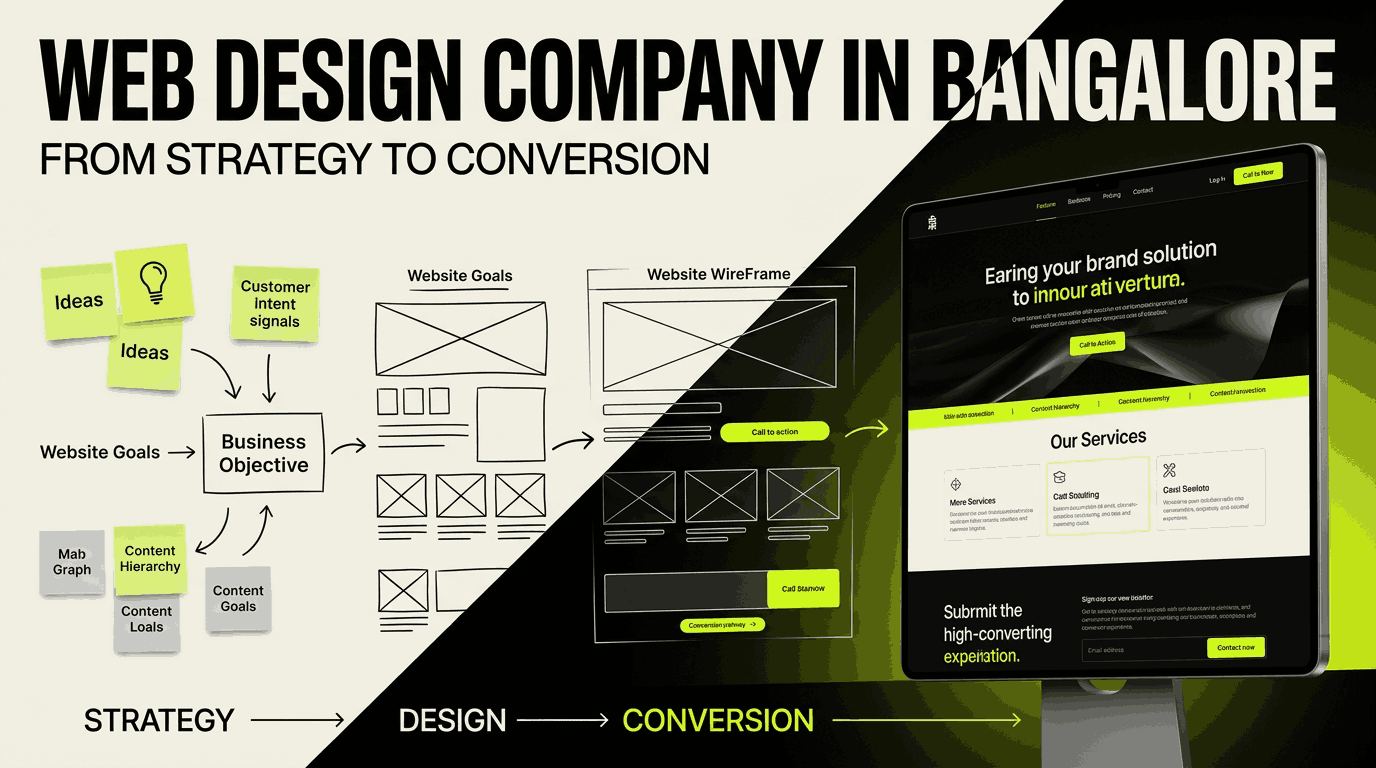
A website often shapes a customer’s first impression of a business. Within a few seconds, visitors decide whether the brand feels relevant, credible and worth exploring. This is why choosing the right Web design company in Bangalore involves more than creating an attractive layout.
For businesses competing in Bangalore’s fast-moving digital market, a website has become an important part of the customer journey. People may discover a company through Google, social media or a recommendation, but the website is often where they decide whether to enquire.
At THE STRATUP, web design brings strategy, user experience, content, SEO and conversion thinking into one process. The focus is not simply on making a website look professional, but on creating a digital experience that communicates value, builds trust and supports measurable business growth.
Start With the Business Goal, Not the Homepage
One of the easiest mistakes in website development is starting with the homepage before deciding what the website needs to accomplish.
A company may say it needs a “modern website,” but modern is not a business objective.
The actual requirement might be to:
- Generate more qualified enquiries
- Increase calls and consultation requests
- Improve visibility for important services
- Present a stronger brand image
- Support sales teams with better information
- Introduce a new service or market
- Improve the experience for existing customers
A lead-generation website, for instance, needs strong enquiry paths and persuasive service pages. An ecommerce website needs product discovery and a frictionless purchasing journey. A B2B website may need detailed solutions, case studies and proof of expertise.
Put Customer Intent at the Centre of the Experience
Your website may be organised around your company, but visitors arrive with their own priorities.
A potential customer might be searching for a service, comparing providers, checking credibility, looking for pricing information or trying to determine whether your company serves their location.
These different motivations create different journeys.
A website should therefore anticipate the questions that naturally occur during the decision process.
For example:
First: “Is this relevant to me?”
Then: “Can this company actually help?”
Next: “Can I trust them?”
Finally: “How do I get started?”
Content and design should work together to answer these questions in the right sequence.
This approach also helps prevent websites from becoming overloaded with information. Rather than presenting every company detail immediately, the website can reveal information according to the visitor’s needs.
A good digital experience feels intuitive because the next piece of information appears when the visitor needs it.
Build the Website Structure Before Designing Screens
Great visual design cannot compensate for a confusing website structure.
Before individual pages are designed, the website needs a clear information architecture. This defines the relationship between pages and helps visitors move naturally from one topic to another.
A typical business website might include:
| WEBSITE AREA | PRIMARY PURPOSE |
|---|---|
| Homepage | Introduce the brand and main value proposition |
| Service Pages | Explain individual offerings |
| About Page | Establish background and credibility |
| Portfolio | Demonstrate practical experience |
| Case Studies | Show problems, solutions and outcomes |
| Blog | Address questions and build topical visibility |
| Contact Page | Provide a clear conversion path |
A company offering multiple specialised services may need separate landing pages for each audience. A smaller business may benefit from a simpler structure with fewer, stronger pages.
Make Every Page Part of the Conversion Journey
A conversion does not always happen through the main contact page.
A visitor may decide to enquire immediately after reading a service description. Someone else may become interested after viewing a case study. Another visitor may need to read several articles before becoming comfortable enough to contact the company.
This is why conversion opportunities should be distributed throughout the website.
A Website Design Company in Bangalore should think about where visitors naturally reach moments of interest.
Useful CTA placements can include:
- After a key service explanation
- Beside relevant case studies
- Below strong proof points
- After answering common objections
- At the end of detailed service pages
- Within high-intent landing pages
The CTA itself should also match the situation.
“Request a consultation” may work better for a professional service than a generic “Click Here.” “View Our Work” may be more appropriate when a visitor is still researching.
The goal is to provide a logical next step rather than interrupting the experience.
Design for Mobile Visitors From the Beginning
A website that looks excellent on a large monitor can feel completely different on a smartphone.
Text becomes harder to scan. Navigation takes more effort. Forms can become frustrating. Images may consume valuable screen space. Buttons may be difficult to tap.
These problems are avoidable when mobile experience is considered from the beginning rather than treated as a final development check.
A Responsive Web Design Company in Bangalore should consider how the entire journey behaves on smaller screens.
That includes:
- Navigation
- Typography
- Images
- Forms
- Buttons
- Spacing
- Content hierarchy
- Interactive elements
- Page loading
Mobile design should not simply be a smaller version of desktop design.
The content hierarchy may need to change. Some decorative elements may need to disappear. Important actions may need to become more prominent.
The result should feel deliberately designed for the device, not adapted as an afterthought.
Bring SEO Into the Design Process Early
A website can be visually impressive and still struggle to gain organic visibility.
One reason is that SEO was introduced after the design and development decisions had already been made.
SEO-friendly web design begins much earlier.
The website structure should provide clear relationships between important pages. Page headings should communicate topic hierarchy. URLs should be logical. Internal links should help visitors discover related content. Images should be optimised. Important text should remain accessible to search engines.
Content planning also matters.
If a business wants to rank for several commercially valuable services, each service may require a dedicated page rather than forcing every keyword into the homepage.
A Professional Web Design Services in Bangalore strategy should therefore bring SEO, content and UX into the same planning conversation.
This creates a website that is easier for people to use and easier for search engines to interpret.
Let Website Speed Influence Creative Decisions
Visual creativity has value, but speed has value too.
A website filled with oversized images, unnecessary animations and excessive scripts can create a frustrating experience. Visitors do not necessarily care how technically impressive a website is if they are waiting for the next section to appear.
Performance should therefore be considered alongside design.
Practical improvements may include:
- Compressing large images
- Using suitable image formats
- Reducing unnecessary scripts
- Loading assets efficiently
- Limiting excessive animation
- Optimising fonts
- Improving server response times
- Monitoring Core Web Vitals
This does not mean every website needs to look minimal.
A premium website can still have strong visual storytelling. The difference is that each design element should contribute to the experience instead of creating unnecessary technical weight.
The best creative decisions are often the ones that balance appearance with usability.
Give Service Pages Enough Depth to Earn a Decision
A service page should do more than announce that a service exists.
Someone arriving through a commercial search may already be comparing several providers. The page needs to help that visitor decide whether the company is worth considering.
A strong service page can cover:
The problem: What customer challenge does the service address?
The solution: What does the company actually provide?
The process: What happens after the customer gets in touch?
The value: What benefits can the customer reasonably expect?
The proof: Why should the visitor believe the company can deliver?
The next step: How can the visitor move forward?
This structure supports both users and search visibility.
It also creates opportunities to answer specific questions that often stop customers from enquiring.
A page that anticipates those concerns can do much more selling than a page containing only a short service description.
Choose Customisation Based on Real Requirements
Customisation should solve a problem, not simply sound impressive.
A Custom Web Design Company in Bangalore can be particularly useful for businesses that need unique functionality, specialised customer journeys, distinctive branding or integrations with other systems.
However, not every business requires a completely bespoke platform.
The decision should consider:
- Business objectives
- Number of pages
- Content complexity
- Required functionality
- Integration requirements
- Future scalability
- Budget
- Maintenance requirements
A template can be perfectly suitable for one business and completely restrictive for another.
The right solution is the one that supports the business without creating unnecessary complexity.
Use Content to Build Long-Term Search Visibility
A website should continue attracting relevant visitors after its main pages are published.
This is where strategic content becomes valuable.
A business can create supporting articles around questions and topics connected to its core services. These articles can target informational searches while linking readers toward relevant commercial pages.
For example, a web design business might create content about:
- Website redesign planning
- Mobile-first design
- Conversion-focused landing pages
- Website performance
- UX mistakes
- SEO-friendly site structures
- Ecommerce experiences
- Website maintenance
- Content architecture
These supporting topics can strengthen topical relevance and create additional entry points from search engines.
The important point is to avoid publishing content simply to increase the number of articles.
Measure Actions Instead of Vanity Numbers
A website receiving thousands of visitors may still be underperforming if those visitors never take meaningful action.
Traffic is useful, but it is only one part of the picture.
Businesses should also monitor:
| METRIC | INSIGHT |
|---|---|
| Organic Visits | Search visibility and discovery |
| Engagement | Content relevance |
| CTA Clicks | Interest in the next step |
| Form Starts | Initial conversion intent |
| Form Submissions | Lead generation |
| Conversion Rate | Overall effectiveness |
| Landing-Page Performance | Page-level opportunities |
| Search Queries | User intent and content opportunities |
These metrics can reveal where improvements are needed.
Treat Launch Day as the Beginning
A website should not be considered finished the moment it goes live.
After launch, real visitors begin interacting with it. Their behaviour can reveal things that planning could not.
Perhaps visitors are spending considerable time on a particular service page. Maybe a certain CTA receives very few clicks. Perhaps a blog article is attracting search traffic and could be expanded into a stronger landing page.
These signals create opportunities for improvement.
A website can evolve through:
Launch → Measure → Identify friction → Improve → Test → Repeat
This approach is especially useful when the website is part of an ongoing SEO and digital marketing strategy.
Instead of rebuilding the website every few years, businesses can make continuous improvements based on actual customer behaviour and changing business requirements.
Frequently Asked Questions
How does website strategy affect the final design?
Strategy determines who the website is for, what it needs to communicate and what actions visitors should take. These decisions influence navigation, content hierarchy, page layouts and CTA placement.
Can web design improve SEO performance?
Yes. Website architecture, mobile usability, page speed, internal linking, headings and content structure can all support SEO when considered during the design and development process.
How can a business make its website more conversion-focused?
Start by identifying the actions that matter most to the business. Then make those actions easy to find through relevant CTAs, clear service information, trust signals, concise forms and well-structured customer journeys.
What should businesses check before choosing a web design agency?
Look at the agency’s strategic approach, portfolio relevance, UX process, SEO understanding, technical capabilities, communication and post-launch support. A visually attractive portfolio alone does not guarantee a successful website.
Does a business need a separate page for every service?
Not necessarily. Separate pages are useful when services have different audiences, search intent or requirements. Combining unrelated services into one page can make the content less useful for both visitors and search engines.
Why is mobile-first thinking important for web design?
Mobile visitors often interact with websites in shorter sessions and on smaller screens. Designing around their needs helps improve readability, navigation, interaction and overall usability.
Conclusion
A high-converting website is the result of connected decisions rather than one isolated design trend.
It starts with a business objective, moves through customer research and information architecture, and then brings together content, UX, visual design, SEO, performance and conversion strategy.
The result should be a website that feels clear to visitors and useful to the business.
For THE STRATUP, the goal is to create websites that continue working after the launch date attracting relevant visitors, communicating value, building trust and creating opportunities for meaningful enquiries.
When strategy comes first, design has a clearer purpose. And when design, content, SEO and conversion thinking work together, the website can become one of the most valuable digital assets a business owns.